Showing posts with label Buddhism. Show all posts

Friday, September 13, 2019

Why Buddhism encourages veganism

I just realized that for all my postings on facebook, there was no solid website which I had pen down my thoughts on Buddhism and veganism issue. It'll be easier to track and search for if I just write it all down here. So here goes. I am a Buddhist and a vegan.

I think it's clearly wrong to try to twist the Dhamma into saying that all Buddhists must be vegans as the Buddha didn't make it compulsory. However I shall be taking the stance that all Buddhists who has compassion and wisdom should be vegans, highly encouraged to be vegans, and it's ok for social pressure to push every humans to be vegans, just short of making it compulsory.


For those who hide behind the excuse that Buddha was not a vegan, why should I be? Do these vegans think that they are morally superior to the most moral being (Buddha)? I say that those excuse are cowardly in this day and age. In the time of the Buddha, there was no issue of global warming caused by human activities, in particular, the meat industry plays a huge role. It's also clear that while the Buddha didn't ban meat althoughter, he does make an effort to not encourage meat eating as well.


My suspicions of why the Buddha didn't outright say veganism is compulsory is for the consideration of the beginners to Buddhism. Clearly the Dhamma food is more valuable compared to physical food. So to set the bar high that all who converts to Buddhism must be vegans would turn people away from the Dhamma rather than towards it. Also, he might have foreseen that for some parts of human history and location where Buddhism goes, it might be impractical for those people to become vegan, and thus Buddhism would not take root there with the vegan requirement.


Now, however, the world has a lot of strong secular reason to go vegan: environment, to avoid cruelty to animals and for their own personal health. It's possible one day to have everyone on earth to be vegan, and thus Buddhism shouldn't be a bastion for the last meat eaters to justify continuing eating meat. And now, it's very practical for most humans in all locations of the world to turn to veganism, as long as there exist a supermarket nearby. For as long as the whole world is not vegan yet, I would agree that it's too high a bar to set to beginners to ask them to be vegans in order to be Buddhists.


But for those of you Buddhists who had been in the Dhamma for years. Maybe say 5 years is a lot already, those of you who are serious in the practise of generating metta, boundless loving kindness towards all beings. Do direct your loving-kindness towards the animals now trapped in factory farming, due to being slaughtered, those male chicks in egg industry due to being killed immediately because they are deemed worthless. Those cows who gets raped repeatedly just to produce milk and their baby who gets killed soon after birth. Use that as a motivation to go vegan and align your actions with what you profess to believe.


Here are some reasons why Buddhism strongly encourages veganism:


1. The first precept: It's to avoid killing. To reconcile the ability to eat meat while practising the first precept, the precept means no direct killing. So don't eat live food, like insects, seafood, osters, octopus etc. Also, don't order for a fish to be killed just to be served for you. But that's only the basic step.

If we go beyond the first precept, it's logical to try to develop avoiding indirect killing as much as possible too. That means going vegan. Even if there is some blood in the harvesting process for plants, it's much less compared to the meat industry, as the animals eat much more plants and then get killed too. That's also a natural result of practising loving-kindness. We want to be able to reduce other's suffering as much as possible.


2. Right livelihood: avoid trading in meat, living beings, weapons, poison, alcohol, also avoid livelihood which breaks the 5 precepts. How is one able to still eat meat then? It's to eat meat prepared by butchers of other religions. It's to have cognitive dissonance that buying has nothing to do with the trade.
So a Buddhist majority country like Thailand, Myanmar who are not also majority vegans do have to deal with uncomfortable truths. The meat they enjoy is due to the presence of some butchers of other religions, regardless of whether the meat comes from outside or inside their borders. So is that not a bit hypocrite? To have others bear the kamma of killing just so that one can enjoy meat?
To link up the act of buying with trade, it's obvious that if we buy meat, we are the paymasters of the butchers, even if it goes through several layers of middle man, the intention is still clear. Meat buyers send a message to those involved in the trade of meat, living beings that their livelihood is ok, is supported by them. It's like buying guns from weapons dealers, you give money for them to continue operate to cause a lot of harm in the world. Is that really ok with your conscience?


3.  Jivaka Sutta:  In three cases I say that meat may not be eaten: it’s seen, heard, or suspected. These are three cases in which meat may not be eaten.
In three cases I say that meat may be eaten: it’s not seen, heard, or suspected. These are three cases in which meat may be eaten.
Keep in mind that the Buddha was referring to the monks and nuns when applying this sutta. So it's not the case that all meat are allowed to be eaten by them. Many lay Buddhists do try to apply the same sort of standard to them and it's pretty good too, at least it means one will not participate in eating live food. How people can continue eating meat is when eating meat, one does not give rise to unwholesome intentions, not harm others, not wishing for any sort of particular food, eg. meat. In the sutta too, the Buddha said those who deliberately kills to prepare meat for him and his disciples have great unwholesome kamma. 
 “Jīvaka, anyone who slaughters a living creature specially for the Realized One or the Realized One’s disciple makes much bad karma for five reasons.
When they say: ‘Go, fetch that living creature,’ this is the first reason.When that living creature experiences pain and sadness as it’s led along by a collar, this is the second reason.When they say: ‘Go, slaughter that living creature,’ this is the third reason.When that living creature experiences pain and sadness as it’s being slaughtered, this is the fourth reason.When they provide the Realized One or the Realized One’s disciple with unallowable food, this is the fifth reason.
So the usual logic for lay people to continue offering meat to the monks and nuns is that they didn't personally do the slaughtering.
Now, let's extend this principle further. Not seen, heard or suspected. Does it have to be seen and heard the exact animal being killed, so I cannot eat that particular animal if I go visit a slaughterhouse? But then I can eat another animal, prepared from different slaughterhouse? Does seeing and hearing needs to be live, in person? Or is a recording of it is sufficient? If a recording of it is sufficient, then those who watched youtube videos of animal slaughters should know better than to continue eating meat. And on suspect, does that imply knowledge? So anyone who's not a kid, who knew that meat comes from killing animals should suspect that this meat had been killed.
Yet, the usual come back is that it's not killed specifically for you. But who are the animals killed for then? The consumers, the customers, those who buy. We can clearly say that monks who don't have the power to buy food is not what the meat is killed for. But the layperson who has the power to buy food would clearly suspect that this meat is killed for them. That happens the moment one exercises the power to buy and choses the cruel option. So one way of practising this is that monks and nuns can eat meat, but it should be only been offered by those who had not specifically buy meat for them, but by those who had already gotten meat, didn't have anything else to offer, then they have generosity to offer to the monks and nuns. That's a pretty rare occasion. Especially if the lay persons who wishes to follow the Jivaka sutta should themselves refrain from buying meat. Basically the only meat available are maybe roadkill, or their friends offer to them. 
4. Metta: loving-kindness. And applied to beings who suffer, it's compassion. Compassion crucially is not only wishing that other's suffering is gone, but to act to help reduce suffering. One way to continue eating meat despite having practise these is to have cognitive dissonance, one does not have these feelings outside of meditation or that it's not universally applied. More applied to humans than the animals due to be slaughtered. Those not yet to be born, but due to be slaughtered in the future as well.
As highlighted above, it's a pretty powerful tool to help set the motivation for going vegan by applying metta towards the animals to be slaughtered, and those to be born to be killed. The reason why so many animals can be killed in the first place is because humans force breed them to meet the demands of meat. So going vegans is having compassion for those to be born. Also, when it comes right down to it, all three reasons for going vegans are compassion. Environment is compassion for the humans and animals of this planet, to avoid them from facing worse global warming. Health is compassion for oneself to have the best interest of one's health at heart when choosing to go vegan. And of course the animals themselves. 
5. The Buddha didn't ban monks from being vegans. When meat eater Buddhists respond to vegan promoters, they usually bring up the story of Devadatta trying to convert the monks and nuns to be vegetarians. 
Looking closely at the story, it's clear that the Buddha also didn't say that lay Buddhist cannot be vegans. The Buddha allowed for pure meat (not seen, heard or suspected), but he didn't outright say that monks and nuns themselves cannot choose to be vegans. He just didn't make it compulsory for them to be one. Granted it's super hard for monks and nuns to be vegans at the time. However, in many places now the Theravada meal offerings are in buffet style, so the monks can choose what food to eat by themselves. The choice of food may be interpreted by the lay people who are offering it as oh this monk likes that meat, next time we should always prepare that meat for them. So it can cause indirect harm in this way. One way for monks and nuns to help is to declare themselves as vegans and have Dhamma talks encouraging veganism, and only choosing the vegan dishes at meal offerings which are buffet styles. This way of living by example can encourage a lot of the disciples to offer only vegan food and maybe even turn vegan themselves, helping with reducing suffering in the world. 
6. Dependent Origination: buying creates demand which drives future killing, present killing is due to future demands. Some people use this time lag and distance from the killing from the mass of economic process of transferring meat to lay aside the responsibility of meat eating to killing of the animal. While it's true that in the story of the serial killer who was demanded by the people to be caught and then sentences the serial killer to death, the kamma of killing is due to the executioner and the judge rather than the public who demanded safety. So it is with the meat. However, it's also possible to imagine a world without capital punishment. Thus no killing is done. It's possible to imagine a world of vegans, thus minimizing killing. As a world of vegans involves the work of everyone, is it not better to choose to go vegan in pursuit of that hope rather than base our actions only on kamma? Don't say that it's impossible to have a world of vegans. Slavery used to be common place. Women used to be inferior to men. LGBT used to be known as unacceptable behavior. Social change is coming, and it's the vegan time. 
7. Rebirth in the animal realms. As we had undergo beginningless rebirth, it's hard to find anyone who had not been our relatives in the past. Thus most if not all of the meat eaten had at one point in the past been our father, mother, spouse, children, relatives. It's disgusting to think about it and can be a good motivation to abandon meat due to this reason. One way of continuing eating meat is to don't think too much. 
8. The banning of certain animals to the monks and nuns.  The meat of these animals are not to be consumed by monks or nuns. Human beings, elephants, horses, dogs, snakes, lions, tigers, leopards, bears, and hyenas. Ignorance is not an excuse as the Buddha did scold the monk who eat human flesh without inquiring about it. For the dog's case it's that society find it unacceptable for monks and nuns to eat dogs. You can clearly see that cats is missing from the list. Yet it's also easy to imagine such an uproar from people if cat's flesh is served to the monks and is consumed. One way to continue eating meat is to stick to the rules. Meat not of these animals can be eaten. However, an easier way around to go would be just to go vegan. 


In conclusion, many of the articles which discourages the link between Buddhism and vegetarianism does end with that the most effective way to end suffering is to practise the Dhamma rather than to go vegan. I agree with it. But since most people are not going to become instant arahants, or even in this life, on the journey towards enlightenment, one has to eat on the way to enlightenment, with each meal comes a choice. Why not choose a compassionate diet too? Further reading: https://sujato.wordpress.com/2012/01/28/why-buddhists-should-be-vegetarian-with-extra-cute/


Friday, April 17, 2015

Earth Hour Metta Meditation


28th March 2015, Saturday night was Earth Hour, from 8:30pm-9:30pm. Kong Meng San Phor Kark See Monastery Gratitude Corner organized a special observance of the Earth Hour: Metta Meditation. Instead of the usual celebratory festival mood, it is suitable for Buddhists to have a more serious approach to a reminder event.


24 participants sat in the open, behind the Hall of Great Compassion. It's a great way to be in touch with the outside air again and to remind us.


The reminder is to have us remember to live a lifestyle that is consistent with a sustainable planet. To have lifestyle change, first our actions has to change, our actions is also influenced by our speech, which is influenced by our thoughts and it all sprang from our views. Inline with that, the Green education part was from 7pm onwards until 8:30pm. There was a 21 minute video of glacier melting, the interdependence of climate change, hope for a green future, evidences of rebirth into humans and the call for working together to have a solution. Together these videos achieved the goal of having the green view of the participants.


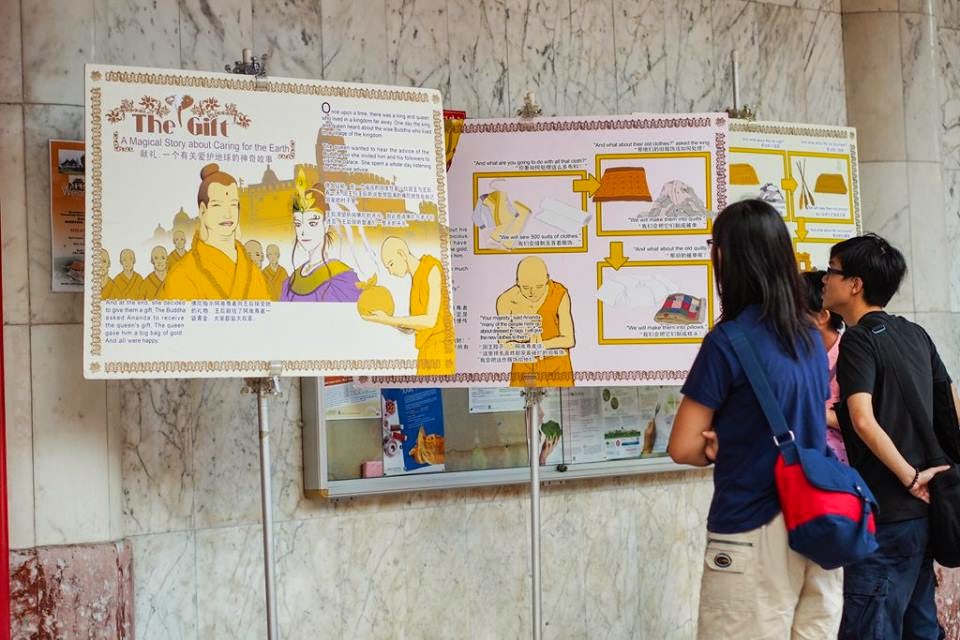
There are also poster stands, presenting a story in the Vinaya, Culla Vagga about how the order of the Sangha had been environmentally conscious. In the story, Ananda described how they reuse their old robes by turning them into cover sheets. With the old cover sheets becoming floor sheets, then covers for pillows and mattress, foot towels, then dusters, and finally, the old dusters are shredded up knead into mud and spread out on the flooring.

This shows the level of commitment that Buddha has for environmental protection.


We also had a time to show the official Earth Hour 2015 video! The point of Earth Hour is not to be green only during this hour, but to go beyond the hour, to commit to a greener lifestyle for the coming year and recommit every year!


Then Venerable Chuan Guan gave us a Dhamma talk about how practicing the Dhamma and turning off air-conditioner is one of the best ways to be green. In practicing non-greed, non-attachment, one is not bothered if the air-conditioning is turned on or not. An air-conditioner takes up to thousands of watts of electricity, and most of the other appliances in our home takes up to a few to a hundred watts of electricity. Or compare it with a standing fan of only 75 watts!

We are also introduced to the concept of Metta Meditation and how by realizing that we are all living in a small fishbowl, whatever we throw at the earth, is actually throwing at our small fishbowl. We are all interdependent, thus having love for us and other sentient beings means having to include loving the small fishbowl that we live in.

Metta Meditation is the training in loving-kindness, having the sincere wish for all beings to be well and happy without any expectations. During the one hour, actual Earth Hour, we had a guided Metta meditation sitting in the dark. Metta Round the World had been our supporter, spreading the idea for this event to all of it's participating organisations all around the world!

The photograph is adjusted for longer exposure so the sky seems brighter than what the naked eye sees. There is an unexpected glow from the dragon as well.
Our photographer had taken the rare opportunity of total darkness in the monastery to capture breathtaking pictures. And our participants and volunteers feedback that the event was meaningful and wishes to have it next year again!

 "The selected venue which was in an open space instead of an enclosed area is very helpful. Though it was just for a short session, it was a fruitful one; especially during the lights off when the area was in total darkness and in mute silence. I feel very closely connected to the nature. It was like I am in an empty space, the universe; calm and peaceful. Hah! I may sounds exaggerating but this is truly what I felt"
                                                                                                                       -ChengYee, Volunteer


 "Earth Hour Metta Meditation was an excellent opportunity for me to reflect upon the scarcity of Earth resources and develop mindfulness of how our way of life can have irreversible consequences on the Earth and future generations to come. I am also more grateful to Earth for providing an environment for Buddhism to flourish. 感恩!"  
                                                                                                                        -Yi Hao, Participant

At the end, we dedicated merits to the late Lee Kuan Yew, Founding Prime Minister of Singapore, all beings, and for the successful climate conference in Paris 2015 for it is the first time that all nations in the world, including USA and China, agree to have a legally binding climate agreement.

As the issue of climate change is urgent, it is hoped that in the spirit of loving-kindness, this event will spread to more and more temples and monasteries around the world and we can help use the power of love to sustain the planet!

Tuesday, September 30, 2014

On the path to enlightenment

Hey old friend,

Dear online diary with no privacy,

I just watched you're the apple of my eye. It brought some tears as I smile and recall my story.

It was one of the big major event or process in my emotional life for the last 4 (has it been so long ago?) years. Yet it's nothing I could not bear with a smile on my face.

It's nothing I could not bear because I had been through worse. I can't believe I would ever say this but I am grateful to has experienced depression about 10 years ago. Doesn't mean that I would wish to experience it again nor wish it upon anyone. It's because of the experience that I am able to understand suffering, to bear through 2 period of unemployment in less than a year without much worry, to be able to generate compassion for all those who are unenlightened, for they are liable to experience these suffering that I had been through.

That makes me want to attain stream winner and help others to do the same as soon as possible. Along this path, should I meet someone whom I had deep kammic connection with in my past life, and that the worldly condition allows us to meet regularly, May I have the strength to choose the greater happiness and not cause undue suffering to others. Remembering the suffering I had been through, my I have Great Compassion that keeps me firmly on the swift path towards enlightenment to benefit all sentient beings. Just like the Buddha who had left his wife out of love for her and all beings to search for the end of suffering, which he did helped his wife to attain it, so may this be an inspiration for me.

At the same time recalling how hard it is for two lovers to come together, I sincerely wish all my close couple friends, all those whom I know, all those in the world, to have mostly happiness in being together and have minimal suffering from their attachments.

Sometimes I used to cry why me? Why did I had to be so deep in the Dhamma that I wish to be a celibate? Tonight I do not think so any more, it's no longer a chain binding me. I am glad to have the aspiration to be celibate to practice well. I am blessed.

At some point on the way to enlightenment, as you to see suffering as just suffering, not "my suffering", then there is no more anger towards suffering, aversion to suffering is gone and there one experiences the impersonality of suffering. One can then bear whatever suffering on the path to enlightenment. These suffering are worth the suffering, because it is the suffering to end all suffering.

Sunday, June 01, 2014

One Dhamma Many Buddhist Traditions

Complied in memory of K. Sri Dhammananda (1919-2006), this book has two parts, first is recollections essays of people who had known him. Second is about the unity of many Buddhist traditions and various issues.

There's 35 essays in total, so I skipped around and marked a tick on the content page to keep track of which I had read before. The essays in the first part of the book really made me appreciate what can a monk do to propagate the Dhamma. It also outlined for me the history of the spread of English based Buddhism in Malaysia from before independence all the way to his death. It was around my father's generation and the generation before him that he was very much influential and helped the build the strong presence of Buddhism in Malaysia as it exist today. We get to see the founding of Buddhist Missionary Society, which has the parallel in Singapore called Singapore Buddhist Mission. And also Buddhist Gem Fellowship, parallel in Singapore is Buddhist Fellowship, both of them having youth groups in Singapore that I am in contact with.

The second part is really essential reading for anyone trapped in sectarian thinking. Monks, Nuns, Layperson from all traditions come together and affirm that there are more similarities between the traditions rather than differences. This really opens up a non-sectarian approach towards Buddhism, promoting harmony and peace amongst the traditions of Buddhism and it can unite Buddhist to rise up to the Modern Challenge of Buddhism meeting the modern age (or information age by now, Civ player would know). One of them is Buddhism and Science, which I am contributing in my other blog. http://physicsandbuddhism.blogspot.com/ Another is to appreciate what's culture in the various forms of Buddhism, and what's the common doctrine.

There are just too many articles to count there but I am amazed to see that I have been in contact with some of the authors via INCOVAR Dhamma Camp. It's quite a good book to balance one's view of the Dhamma, regardless of how deep you have learned in your particular tradition.

Friday, May 30, 2014

29/5/2014

Pali text translation.
Vinaya. Mahavagga. Chapter one, parts of...

This is one of the books in the basket of discipline. Chapter one is quite long, talking about the events after the awakening of the Buddha.

After enlightenment, the Buddha went from tree to tree, staying cross legged for 7 days at each place, enjoying the bliss of liberation. In the first week, he contemplated on dependent origination. In the second week, a brahmin whose practice is to say hum asked the Buddha on what is a Brahmin, and got an answer that the Brahmin. Is not one who says hum, but one who cast out evil.

The third week, there was a great storm that lasted for a week. The serpent king came out of his meditation, coiled around the Buddha 7 times, and spread its hood over Buddha's head, determined to shelter him from cold and heat.

The fourth week, two merchants were advised by their deva relatives to offer barley gruel and honey ball to the Buddha, for their blessing and happiness for a long time. When they offered, the Buddha says that the Tathagatha does not receive with hands. The 4 deva kjngs, having known this, send bowls to the Buddha. The Buddha received bowls made of rock crystals from 4 directions from the 4 deva kings. Thus the Buddha received the food and partook it. The two merchants then took refuge in the Buddha and Dhamma and became the first lay followers of the Buddha.

On the fifth week, the Buddha was reflecting that the Dhamma he had realised is subtle, hard to realise and understand. To teach it would be tiring to him, bringing vexation. To be continued....

I have read the chapter in Sylvia Bay's book in between the lines, an analytical appreciation of the Buddha's life that described the period after Buddha enlightenment and before the first sermon. She contrasted the popular Theravada account of the period with what is said in the Sutta and Vinaya. The Theravada account has 7 weeks, of which a lot of events like staring at the Bodhi tree for a week, walking on a jeweled bridge, contemplating on Abhidhamma, and the three Mara daughters were not found in the Canon. Thus, this remind us to look beyond what we were told and to not attach to even the words of Dhamma, but to practice non attachment in daily life.

Thursday, May 29, 2014

Poh Ming Tse- Bodhicitta M.U.S.I.C programme batch 2 graduation ceremony

On 28th May 2014, Wednesday, a new batch of MUSICians has been born out of the collaboration between PMT and Bodhicitta.

PMT is a quite an old temple in Singapore, but has gotten a new modern looking building in 2009. Since then, Poh Ming Tse has been nonsectarian, allowing any Buddhist groups to rent their place for an event or class. Many classes are held there from all three traditions. Due to it's dedicated and super good committee members, staff and patron, PMT is open enough to make a collaboration with Bodhicitta.

Bodhicitta is a music band formed in 1997, inspired by the Dhamma, since then over 100,000 albums they as produced has been circulated. Their music style is smoothing, and they are nonsectarian, they sing songs based on any of the three traditions. They were looking for young talented Buddhist musicians to train and keep Buddhist music alive and has been in talks with many temples before PMT.

In 2012, the temple and the music band has formed their collaboration and decided to train a selected group of students with interviews to train every week, starting 2013.

Now it's 2014 and the second batch of their first of three modules has just graduated from 10 weeks of weekly Wednesday training. M.U.S.I.C. captures the aim of the MUSICians group. Motivate and Unite the practice of the Dhamma. Smooth the mind, Inspire and Care.

Personally, I know a lot of the batch one and not so many of the batch 2 people. I usually go to these music events as a karaoke session, singing with them. You see I have a large collection of Buddhist songs totalling almost 24 hours of playtime and I played them over and over again during my uni days. I believe I have two of the Bodhicitta albums. So I am quite familiar with their songs. These are nice stress out sessions for me.

Now for the structure, the songs are in many languages, with the session conducted in English, with Chinese translation. The opening puja song was in Pali, then there are English songs, Tibetan Matra songs, Chinese songs were featured too.

The programme trains them in using their musical skills to conduct a Buddhist activity using songs. There are also vocal trainings for the students. After graduation, they have a commitment to fulfill a certain hours of song presentations in PMT and their own Buddhist society. The batch one had presented in concerts, conferences and weddings in addition to the current monthly Sunday service with songs and Dhamma talk in PMT.

The style of their Buddhist music is to use music to allow the Dhamma to sink into people's heart. Thus it is very suitable to bring beginners or your free thinker friends to come and join in their performances. Some songs can even be a guide to relaxation and meditation. Some can lift the spirits up and motivate the listeners. It's also a very suitable place for those who can't learn Buddhism well from sutta readings to learn the Dhamma from the lyrics, tone of the songs, presentation, and the mind of the Buddhist songs leaders. Or if you just like Music, this can be the door for you to enter into the Dhamma.

Here's to greater heights and wider reach of the MUSICians!

Monday, November 18, 2013

Mindfulness: What's the buzz?

Guess what? The world’s happiest man came to NUS to give a talk!
Over 1000 people attended this event on 6th November 2013 in the University Cultural Centre. For more official information, take a look here.
That night, there were eight speakers, with Professor Jay L Garfield as the moderator. All their profiles can be viewed here. The edited excerpts below may be time-consuming to read but their discussions of mindfulness is well worth learning!
So here are the eight take-home messages by the eight speakers:
  1. Mindfulness can help in recovering from mental disorders.
  2. Mindfulness is to be experienced by oneself, not just read or studied.
  3. There are well-designed, long-term studies on the effects of mindfulness practice, and it’s all good news.
  4. Mindfulness – being non-judgemental towards others, accepting things as they are – is useful in counseling others, and in opening up your heart and others’ hearts.
  5. The Mind and Life Institute should open up its Asia hub in Singapore!
  6. Mindfulness isn’t enough, we need compassion.
  7. Our brains changes; take control of this change with the practice of mindfulness.
  8. “We need the compassion revolution, let’s go for it!”
We started our discussion with Prof. Kua Ee Heok, a Prof. of Psychiatry in NUS,
“This two hours would change your life. As you can see from the slides, mindfulness in Chinese (念) is not only of the mind, but also of the heart. In Singapore, about 3% of the people with mental disorders are seen by mental health professionals and 5 to 10% by doctors. 20% have some mental disturbances – they can’t sleep properly, which affects their work efficiency, but it isn’t serious enough to warrant labels of mental illnesses. Mindfulness may not treat all mental problems, but it can help a lot of patients.”
Chinese patients with depression associated with diabetes and hypertension are treated with three different methods: Chinese Taoist cognitive psychotherapy (Tai Chi, music, art); Mindfulness therapy; and brief integrative psychological therapy. There is improvement, but no significant difference for the baseline over four weeks for these methods. It is established that these methods are effective, non-medicinal ways to treat mild depression. This is important to prevent the worsening into clinical depression.
He concluded with this statement,
Practicing mindfulness would lead to more compassion, helping the people around you, perhaps even lifting the happiness index of your people (and country).
So far, we have learnt that mindfulness can help in recovery from mental disorders.
Next, we have Dr Arthur Zajonc, the President of Mind and Life Institute.
“Why are you here?
This (Singapore) is no ancient state committed to ancient practices, but a modern society that lives with its heritage. How does one bring these two worlds, of mindfulness and modernity together?
The Mind and Life Institute has been living in the crossing point of Science and Mindfulness. The Mind and Life Dialogues was started at the MIT and gave birth to the Mind and Life Institute. These two great traditions of Buddhism and Modern Neuroscience seeking to investigate the mind are finding their way to a common point because there are suffering humanity.
Questions including “how is it that higher aspirations are obstructed by the addictions in life?” are explored.
When you talk about mindfulness, it is like talking about food. You can talk about it after that, but the function is to cook the food and eat it.”
Dr Zajonc then guided us into a live session of mindfulness training.
“Just sit back, relax, calm down in your seat, calm your mind and pay attention to your breathing.” Here is a sample meditation instruction.
We spent three minutes in our meditation. Some of the audience still refused to open their eyes after the three silent minutes.
Our second point: Mindfulness is to be experienced by oneself, not just read or studied. 
Our third speaker is Dr Clifford Saron, research scientist at the Centre for Mind and Brain.
He investigates what people do when they meditate. However, because it is hard to see into the mind directly, it is more concrete to investigate what people do (differently) after they had meditated.
He introduced us to the central characters in a unique research dialogue: Francisco Varela and Alan Wallace. In fact, most of the speakers there are friends. Some for decades long!
He explained how sadness relates to compassion.
“Sadness can be a catalyst. At some point, you may see suffering until it is unbearable to allow its continuation while being clear-headed enough to see how you can help.”
Alan Wallace taught two 3-months-long shamatha meditation retreats where participants meditate full-time. 60 people from around the world were randomly assigned to training and into two wait-list control groups of 30 persons each.
The first group was exposed to the three months retreat, with the second group as control (not in retreat). They fly the second group in for many of their tests. After a few months, the second group then took part in a separate retreat.
The taught meditations included:
  1. Focus attention meditation; Mindfulness of breathing; Awareness of awareness and
  2. Opening the heart, in particular of the four immeasurables (loving-kindness, compassion, altruistic joy, equanimity).
The expected outcomes are: improved ability to withhold hurtful speech, and to be able to empathize with people more.
They employ multidisciplinary measures, including but not limited to: brainwave measuring, magnetic resonance imaging…..and came up with a measure they describe as Adaptive Functioning. Generally, the higher the score, the more positive a person is.
The results? The retreat group’s scores go up while the control group shows no change. However, after the control group goes into their retreat, their scores go up as well.
Studies has also shown that telomerase (the end of DNA that shortens every time a cell multiplies) increases for mindfulness meditators. This means we can live longer with mindfulness practice!
For the participants, there is a general change in purpose towards life after the retreat.
There are also other factors that they test on, in particular a test on attention. It’s a boring test where the participants have to press a button every time they see a long line and abstain when they are shown a short line. The short lines are rarely shown. This test is hard because they made it difficult to tell the long lines from the short ones.
As you can predict, the score gets better for mindfulness practitioners and it correlates with their scores in Adaptive functioning as well.
The researchers also expect decreased rejection emotions – contempt, disgust and anger – in response to suffering.
To test that, they evoked emotions with intense films and studied the facial expressions of the participants. They even produced a code, measuring sadness based on facial expressions! They found that sadness is a more frequent emotion for retreats-goers and rejection of their emotions are less likely. There is an increased ability to hold complex and painful realities in mind without pushing them away.
The first part of compassion training is to be able to empathize, so this opens the way to compassion training!
Our third point: There are well designed, long term studies of the effects of mindfulness practice, and it’s all good news. 
Our fourth speaker is Dr Carolyn Jacobs, a social worker.
“What is the buzz between mindfulness and social work? It’s like looking through a kaleidoscope. They are constantly changing, but inside it, one could say they are all of our self-identities. Who we are can be shaped, sometimes with a sense of joy. It’s a good skill to be able to enter into people’s life, enrich them, and leave without leaving sadness.”
She related one of her stories.
“Adam, a patient, once visited her. He sang to the woods in the morning, but he was having difficulty in finding time to practice his religion. He thinks he needs to pray in a certain way to fulfill his religious duty.” Dr Jacobs got angry after a year of being his counselor and got counseled instead.
She was reminded of her affirmation towards her ideals: my God loves Adam, however he is, and my job is to breathe with Adam and having the stillness that is born of love and acceptance.
And so, she had the opportunity to practise acceptance the very next time she met Adam.
“Adam came in and said, “Do you mind if I sit on the floor? I need to tell you why I choose you a year ago. I’m going to tell you something that I don’t know if you’re going to accept or not.” He then spoke.”
She knew immediately that this was the time to be non-judgemental. When in doubt, breathe deeply.
“Adam told me that  he had a dream, of stealing, and there was an Afro-American police in his dream. That was the reason he chose me, but the real reason for his unease was that he had been engaged in an affair at around that time too. The ability to be open during our conversations was blocked by the secret of him having an affair.
“Now you’re going to have to deal with your wife and your sense of religion. Next time I want to hear you talked to your wife.” And he did precisely that.”
She ended with this: “your practice becomes clear when you can look into your heart. Who looks outside dreams, who looks inside awakens.”
Our takeaway: Mindfulness – being non-judgemental towards others, accepting things as they are – is useful in counseling others, and in opening your heart and another’s heart. 
Fifth up, we have Dr Diego Hangartner, Chief Operating Officer of Mind and Life Europe.
He was an Olympic level athlete and said that it was his training that brought him there. It is the mental strength to go through the boring training that gets people to such sporting pinnacles; it is the drive to be successful.
He studied pharmacology and specialized in addiction studies. Any addiction begins with the mental desire to experience happiness. One day, he went to Nepal, a place where people were more happy despite the sicknesses there. In comparison, his homeland, Switzerland is clean, but mentally, it is degrading. He thought, “we are experiencing an epidemic of mental illnesses.” And he wondered if there was a Science of the Mind. Then, he discovered Buddhism, learned it for 11 years in Tibet, including being a monastic, and eventually got involved in the Mind and Life Institute.
One of the goals of the Mind and Life Institute is to catalyze contemplative traditions with science, making it a contemplative Science.  There are representatives from the Christian traditions too.
What do Mind and Life Europe do? They promote Mind and Life’s Vision and Missionand translate successful initiatives from Mind and Life.
Among many of their projects are Altruism and Compassion in Economic Systems. Economics, typically concerned with money and resources, is flawed so they are rethinking it with altruism and compassion included.
They will have the next public dialogue and conference with European Symposium on Contemplative Studies in Berlin.
Also, there is the Mind and Life summer research institute where they train scientists to pursue this field. They have established a grant system to seed research in Education, Human Development, Flourishing Initiatives as well as Research Initiatives from first and third person perspectives.
The take-home message? Mind and Life should open up its Asia hub in Singapore! 
Our sixth speaker is Dr Thupten Jinpa, an English translator of Dalai Lama. He shared about “Compassion meditation, the next big thing?”.
“Mindfulness is a buzz, mainly due to works by the Mind and Life Institute.
It is, at its essence, a Buddhist practice which has been completely secularized, to be practiced everywhere. Most of the contemplative practices are from Buddhism, but Dalai Lama advised not to make this a Buddhism-and-Science dialogue but a contemplative science dialogue. There are efforts to invite people of other religious faiths to join in this conversation.”
The next big thing, he believes, is compassion, which is defined as
  • An awareness of suffering (cognitive);
  • Empathic concern (affective); and
  • Wishing to see the relief of that perceived suffering (intention).
The focus is completely on the Other, no longer about the Self. It is often followed by a readiness to help relieve suffering or wanting to do something about it (motivation/action).
For caregivers looking after the terminally ill and mentally challenged, and all of us, eventually caring for our old parents, where does the motivation to care stem from?
The benefit and paradox of compassion are that, by shifting our focus from Self to Others and caring for their well-being, our personal happiness increases as well. It broadens perspectives, improves relationships and gives purpose to our lives. Some studies show how the practice improves health and lengthens life. And we all know the effects of compassion on all of us personally. The one break we get, the one help when we need it most.
The more compassionate you are, the more you benefit from others. So there are Compassion Cultivation Training (CCT) for caregivers and everyone too. The Centre for Compassion and Altruism Research and Education (CCARE) in Stanford provides this training.
“Compassion is a part of our motivation system; to train compassion is to be able to better relate to the people around us.”
The take-home message: Mindfulness is not enough, we need compassion.
Our seventh speaker is Dr Richard J. Davidson,  professor of psychology and psychiatry at the University of Wisconsin–Madison.
His topic: “Change your brain by transforming your mind”. Like other speakers, he shared his appreciation on how he has made lifelong friends around this topic.
So here’s his story: he wanted to learn more about meditation practices from the inside. So after his 2nd year at graduate school, he went to India to learn meditation. These were practices that can literally transform human minds. After he returned, he was told very quickly that if he wants a successful career in science, this is not a good way to start. And so he pursued a traditional science career.
“There is this concept of neuroplasticity. The brain is able to change, shaped by the forces around us, by our interactions with the outside world. Sometimes willingly, sometimes unknowingly. Most of the time it changes unwittingly. The whole buzz about mindfulness is that we are able to shape our brain willingly by this practice.”
There is this study where the participants were sampled by texting them:
What are you doing right now,
Where is your mind right now,
How happy or unhappy are you?
They found that 40% of our waking life is not spent right here and now. The buzz of mindfulness is to reduce that and to enable us to pay attention. Indeed, we consistently report that we feel better when we are mindful. We can actually learn to pay attention, we can learn to be happy, we can learn well being.
Well being is a skill but we often don’t think of it as a skill, this is what modern science has concluded. That we can actually learn well being.
To test the subject of voluntary cultivation of compassion, they bring long-term meditators into the lab and study the differences. These are individuals who have practiced at least 10,000 hours, which is the entry level expertise for any skill. This group of monks has an average of 34,000 hours of meditation. The good thing about long term meditators is that they can control and alternate between the neutral and meditative states. Mathieu Ricard is one of them. By these testings, Mathieu Ricard got the term: happiest man in the world.
They also developed a kindness programme for kindergartens.
Take home message: Our brains changes, take control of it by mindfulness practice. 
Finally, we have Ven. Dr Mathieu Ricard, a Buddhist monk.
“The mind can be our best friend or enemy, we deal with our minds from morning to evening. If we can change somehow the way we work with our mind, we can change how we perceive things. Control of outer conditions is hard, illusionary. At least with the control of our mind, we can perceive which are the mental states that make us happy and which cause us to act and speak in a way that are detrimental to others’ happiness. So that we know how to develop, and what to let go.
When we look at our minds, they are like restless monkeys. They jump so much all the time that we can’t undo their knots. It’s not about banging the monkeys on their heads, but taming them. So that’s what we try to do in mindfulness training. People try and say that they’ve tried but there are more thoughts than before. It’s not that there are more thoughts than before. This shows the extend of this catastrophe.
We started experimenting with different kinds of meditation. There is a specific kind of signature for each mental state. There are these world specialists of empathy. Caregivers, nurses, etc… Imagine that you are a caregiver, day to day, you suffer by resonating with your patients’ suffering. Eventually, you may burnout.
The common advice is to have distance, but this is not ideal. A caregiver is supposed to give care. So during the MRI, a specialist in empathy asked me to generate empathy, I produced loving-kindness and compassion. They found that it’s not the normal signature of empathy. When I came out, I explained that I’ve gone further, I used it as a step for compassion.
They asked me to just try empathy, not compassion. Then, I imagined the suffering of the people I’ve met with just empathy, and within one hour, it was painful. Imagine this for the caregivers. The researchers then said, now you can generate compassion. Ahhh, it’s like a dam bursting open. Imagining every atom of the people suffering to be filled with loving-kindness.
“In the brain there are two different networks. When you train doctors and nurses, it is essential to train compassion to them.” He showed some pictures of compassion in action, something like this:
“This ability to console others. High social support+happiness+length of life.”
It is possible to have various levels of compassion, and the MRI readings matches the meditators’ effort with how much compassion they are generating.
He ended off with: “We need the compassion revolution, let’s go for it.”
The take-home message: “We need the compassion revolution, let’s go for it!”
Finally, Professor Jay L Garfield asked the panelists two questions:
Just what is mindfulness anyway?
Answer 1: There is a fair bit of confusion as to what mindfulness means. Some scholars try to appeal to the scientific sources, or derive it from the Pali or Sati word. Can you say “mindfulness is when you meditate”? Can you define it as defined in the MBSR? Present moment awareness without judgement. The meaning of the word is in its use. So there’s no need to go back to the Pali term and define it.
Answer 2: There is a lot of usage of terms without defining. Definition will change over time. There is a need for some kind of measures, instead of self-reporting measures which have serious limitations.
Answer 3: The challenge of defining the whole Buddhist terminology within one word. Pali, Tibetan, German, etc… Just look at the experience of the person doing that. The first person perspective is the most useful. The observation that you try to observe the mind and it moves… This is something that is evolving and also needs to be contextualized with practice.
There is a connection between mindfulness and compassion, what is the extent of that connection?
Answer 1: If you try to do compassion without mindfulness, you try to do nothing. Mindfulness is the basic tool. Training is necessary. But training doesn’t mean the work of digging a hole in the ground. It can be just lying on the floor, practising mindfulness of compassion. If at the start you train compassion, mindfulness will be there; you get two at the price of one. Fundamental part of the human condition is this sense of love, and if you do it with mindfulness, it is mental training.
Answer 2: It’s like asking a colour-blind to define red. Experience is the one that we need to work on. So we need to practice and spread this to the world.
So here’s a recap of the eight take-home messages:
  1. Mindfulness can help in recovering from mental disorders.
  2. Mindfulness is to be experienced by oneself, not just read or studied.
  3. There are well-designed, long-term studies on the effects of mindfulness practice, and it’s all good news.
  4. Mindfulness – being non-judgemental towards others, accepting things as they are – is useful in counseling others, and in opening up your heart and others’ hearts.
  5. The Mind and Life Institute should open up its Asia hub in Singapore!
  6. Mindfulness isn’t enough, we need compassion.
  7. Our brains changes; take control of this change with the practice of mindfulness.
  8. “We need the compassion revolution, let’s go for it!”
Personally, I recommend taking up meditation courses for our mental well-being. Just like physical exercise is for bodily health, meditation is great for mental health.
Thank you all for reading.

Friday, September 27, 2013

Buddhist extremism and how we should react

So this is a sudden inspired post I'm making. There's this person who joined in one of the facebook group about Buddhism that I made and posted things that promote hatred towards Sri-Lanka Muslim in the name of protecting Buddhism. As I was the admin, I was notified and I took down the post and kicked out the person who posted them.

 Just now I spoke to the person on her facebook wall.

Here's the excerpt, I leave out her name to avoid directed hatred and direct prosecution. Please don't ask me who she is, if you met her yourself, you'll know then.


 HOPE TO GET ALL OF THE MUSLIM BAND &;;; CO LOGO PIC THAT ARE BUSINESS IN SRI LANKA...HOPE MY FB SRI LANKAN FRIEND OR BUDDHISM ORG DO RESEARCH OF ALL MUSLIM BUSINESS THAT OPERATE IN SRI LANKA LOGO TO CREATE IN PIC AND PASTE TO ME...NEXT TIME WILL NOT BUY THEIR PRODUCT &;;; SERVICE FROM THOSE MUSLIM CO &;;; WOULD LIKE TO SPEAD AT FB BUDDHISM GROUP TOO!!!!PLS CREATE THE PIC FORMAT &;;; SEND ME...THANK..
  • Ng Xin Zhao Are you practising loving-kindness while doing this? Unconditional love is one of the core practises of Buddhists.
    23 minutes ago · Like
  • WHAT WRONG ARE U TALKING???MY NOTICFY SHOW NO LOVING & KINDNESS???IS ANOTHER MATTER!!!NO INVOLVE OF AS YOU MENTION LOVING & KINDNESS!!!DONT WANT TO BUY & SERVICE FROM MUSLIM BAND & CO!!!YOU NOT CLEAR ON THEM!!!DEFEND & RESCUS & PROTECT SRI LANKA BUDDHISM!!!
    17 minutes ago · Edited · Like
  • Ng Xin Zhao As a Buddhist, if we don't practise or show loving-kindness (like the capital letters you're using, capital letters means shouting on the internet), it'll present a bad image of Buddhism. Thus in the long run it makes people turn away from the Dhamma instead of bringing them to the Dhamma.
    15 minutes ago · Like
  • THESE IS NOTIFY SO HAVE TO USED ALL CAPITAL LETTER TO SHOW IS IMPORTANT!!!
    13 minutes ago · Like
  • Ng Xin Zhao Yes, but in the comments session, you're also using capital letters, which is unnecessary. Anyway, we have to be mindful of our actions in society (and facebook is a part of society if you put your wall open to the public) and not do actions that causes more discrimination, separation and spread disharmony. Extremism is what is taught by the Buddha to be avoided. And promoting boycott of Muslim product is a form of extremism. Every time news like this: http://www.wsws.org/en/articles/2013/08/13/sril-a13.html pops up, friends around us practising Buddhist may turn to question us, "I thought you Buddhists are all about good one? Why produce such cases like this?" Then it's very hard to teach them about the 4 Noble truths, 8 foldpaths and so on, because they see one bad example, and got disinterested in Buddhism. Thus, as a Buddhist who wishes to promote the Dhamma, I think it's part of my duty to at least talk to people like you to have you see what you are doing to Buddhism.
Her: I am not all open public.have been saw samilar these already..bye...

Me: As I'm not your friend, and still I can see and comment on your wall, this means your wall is public. You can change the facebook privacy settings to make it so that only your friends can see it. But seriously think about what you're doing. If you're not practising the Dhamma, what good is protecting the container of Dhamma (Buddhism)? It'll be an empty container.


Ok now, so the main message that I want to present to you here is to speak out when you met such extremists, speak out and promote harmony instead of hatred (for whatever reasons). Please don't hate her too, it's against my religion to promote hatred.